
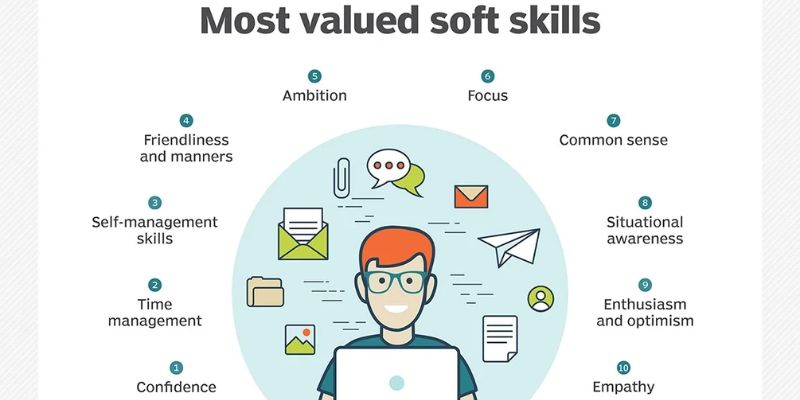
Technical proficiency is no longer sufficient to ensure career success in today’s cutthroat workplace. Soft skills are becoming more and more important to employers since they have a direct impact on problem-solving, leadership, teamwork, communication, and workplace efficiency. Strong soft skills can produce good results and improve organizational performance, whether an individual is managing projects, working with colleagues, or communicating with clients. Because of this, companies now prioritize evaluating these talents throughout hiring, performance reviews, promotions, and employee development initiatives.
Soft skills are more complicated since they encompass actions, attitudes, and interpersonal skills, in contrast to technical skills, which are frequently assessed through exams and certificates. Evaluation becomes more difficult but as crucial as a result. FITA Academy supports learners in developing communication, leadership, teamwork, and interpersonal skills through real-time project-based learning. Employees may enhance their professional skills and businesses can more successfully uncover talent when they are aware of how soft skills are measured. Employers may learn a lot about a person’s capacity to thrive in fast-paced work conditions by utilizing a variety of evaluation techniques.
Understanding Soft Skills and Their Role in Professional Success
Communication, cooperation, leadership, flexibility, emotional intelligence, time management, critical thinking, and conflict resolution are some of these abilities. Soft skills define how well an individual interacts and contributes within an organization, in contrast to hard skills, which concentrate on technical knowledge and job-specific experience. For instance, a software engineer may have outstanding coding skills, but in order to communicate concepts to clients and team members, they must have good communication skills. Similarly, in order to effectively lead teams, managers need to possess both leadership and decision-making abilities.
Employers are aware that workers with good soft skills frequently exhibit increased output, greater teamwork, and enhanced customer interactions. Employers are giving these skills more weight when hiring and assessing candidates since they have a big influence on workplace culture and business results. Organizations can find people who can succeed in a variety of changing work situations by measuring soft talents.
Why Measuring Soft Skills Is Important
Assessing soft skills provide important information about an employee’s capacity to function well in actual work environments. Finding applicants and team members with the interpersonal skills necessary for success is crucial since organizations spend a lot of money on employee development. By assessing attributes that technical exams are unable to quantify, soft skill evaluations assist businesses in making well-informed recruiting selections. By recognizing future leaders with excellent communication, flexibility, and leadership skills, they can aid with succession planning. Soft Skills Training In Chennai offers practical, industry-focused guidance in communication, leadership, teamwork, problem-solving, interpersonal skills, and professional development.
Measuring soft skills also aids companies in enhancing workplace culture and team interactions. For instance, managers can offer specialized training and assistance by detecting communication issues within a team. These assessments help employees recognize their strengths and opportunities for growth, which is another advantage. Organizations may link people development plans with business objectives and cultivate a more engaged, productive, and collaborative staff by regularly monitoring soft skills.
Common Methods Used to Assess Soft Skills
Since no single test can adequately gauge all interpersonal skills, organizations employ a variety of techniques to assess soft skills. One of the most popular methods is the structured interview, which enables employers to evaluate a candidate’s communication, confidence, and problem-solving abilities through specific questions. During behavioral interviews, candidates are frequently asked to discuss their prior experiences and explain how they dealt with particular job circumstances. Self-assessment surveys provide workers the chance to consider their own advantages and disadvantages, promoting self-awareness and personal development.
Because coworkers frequently detect behaviors that supervisors might miss, peer feedback is another useful technique. Organizations can assess teamwork, leadership, and interpersonal communication abilities through team activities and group discussions. Role-playing situations are used by certain organizations to mimic working difficulties and track candidates’ reactions. Employers may make more accurate recruiting, development, and performance management choices by integrating several assessment techniques to obtain a more thorough grasp of a person’s soft skills.
The Role of Performance Reviews and 360-Degree Feedback
In businesses, performance evaluations are crucial for assessing and fostering soft skills. Managers evaluate workplace interactions, employee behaviors, and overall contributions to team performance during these assessments. Criteria including collaboration, leadership potential, communication effectiveness, and flexibility are frequently included in traditional performance appraisals. However, by introducing 360-degree feedback systems, some firms have broadened their evaluation procedures. In order to present a comprehensive picture of an employee’s interpersonal skills, this method gathers input from peers, supervisors, subordinates, and even customers. B School in Chennai can significantly boost your career readiness and employability by enhancing your communication, leadership, teamwork, problem-solving, and interpersonal skills through comprehensive soft skills development.
For instance, a manager could think that a worker communicates well, while coworkers can point out areas where the worker might do better in terms of teamwork or listening. Organizations may lessen prejudice and improve their comprehension of soft skill performance by compiling viewpoints from many sources. Detailed feedback also helps employees by highlighting particular areas for improvement. Frequent evaluations and feedback mechanisms promote lifelong learning and long-term career development.
Evaluating Communication, Teamwork, Leadership, and Adaptability
Employers frequently emphasize particular soft skills that have a direct impact on productivity at work. Interviews, presentations, written assignments, and daily encounters are frequently used to evaluate communication abilities. Organizations assess people’s ability to communicate ideas clearly, listen intently, and react to others. Peer reviews and cooperative projects are popular ways to gauge teamwork as they show how well employees can collaborate with a variety of organizations. Decision-making skills, methods to dispute resolution, and the ability to inspire others are all used to evaluate leadership talents. In today’s settings, adaptability has grown more crucial, particularly when companies undergo quick organizational and technical changes.
Employers can assess an employee’s adaptability by looking at how they handle unforeseen difficulties, shifting priorities, or taking on new duties. Case studies, simulations, and real-world situations that call for creativity and critical thinking are frequently used to evaluate problem-solving abilities. Organizations may find people who can favorably impact team performance and organizational success by measuring these essential abilities.
The Use of Psychometric Tests and Workplace Simulations
To measure soft skills more objectively, several firms employ workplace simulations and psychometric tests. Psychometric examinations assess behavioral patterns, emotional intelligence, personality traits, and cognitive skills that affect productivity at work. Employers may better understand how people would react to different professional circumstances and interact with coworkers by using these exams. This is how can you develop assertive skills. Assessments of personality frequently reveal information on collaborative preferences, leadership potential, and communication approaches. By putting participants in authentic situations that closely resemble real-world professional duties, workplace simulations go beyond evaluation.
Candidates could engage in problem-solving tasks, group activities, or customer contacts, for instance, while assessors watch how they behave. These simulations offer important proof of how people use soft skills under duress. Instead than depending just on self-reported experiences, employers may see behaviors in real time using simulations, unlike traditional interviews. Psychometric exams and simulations can provide deeper insights into a person’s abilities and possible areas for improvement when applied appropriately.
Challenges in Measuring Soft Skills Accurately
Despite their significance, soft skills can be challenging to evaluate precisely because they include interpersonal interactions and subjective human behaviors. The same conduct may be interpreted differently by multiple assessors, leading to inconsistent evaluation outcomes. An employee’s aggressiveness, for instance, can be seen as leadership potential by one boss but as excessively aggressive conduct by another. Evaluations may be made more difficult by cultural differences, communication styles, and working settings. Because people frequently overestimate or underestimate their talents, self-assessments may also provide erroneous findings.
Furthermore, some workers behave differently in formal evaluations than they do in regular job settings. Careful planning and a variety of assessment techniques are necessary to minimize bias and increase reliability when measuring soft skills. Businesses may miss crucial facets of employee behavior if they just use one assessment instrument. Businesses may develop a more precise and fair method of assessing soft skills by integrating performance assessments, simulations, feedback systems, and interviews.
Best Practices for Improving and Tracking Soft Skill Development
Soft skill measurement is only useful when businesses apply the findings to promote the development of their workforce. Setting clear standards for leadership, teamwork, communication, and other critical skills is one of the best strategies. Regular feedback that identifies areas for development and acknowledges strengths should be given to employees. Individuals can develop certain soft skills through coaching sessions, workshops, mentorship relationships, and tailored training programs. Additionally, companies should promote lifelong learning by offering chances for teamwork, leadership training, and professional growth.
Establishing quantifiable objectives enables staff members to monitor advancement and maintain motivation throughout the process of development. Ongoing evaluation and development can be further supported by technology platforms and performance management systems. Frequent evaluations, as opposed to just annual reviews, guarantee that growth is tracked over time. Organizations may improve workplace culture, strengthen teams, and boost overall company success by investing in ongoing soft skill development.